

The Stew
I have this lamb stew recipe. It’s yummy stew. Besides lamb, the recipe calls for various spices and some vegetables, including a red onion and a bell pepper. The red onion and bell pepper are good partners, adding complementary flavors to the lamb and spices in the stew.
One day, a while back, I planned to make the lamb stew. After taking an inventory, I realized I was missing the onion and bell pepper. So, I proceeded to my local Kroger-owned grocery chain store. It is a Fred Meyer in the Seattle neighborhood called Ballard. I went in the morning before the rush of shoppers. I entered the store and went straight to the produce section. In the morning, the produce area is pristine, prim, and proper before the onslaught of the day’s shoppers. I stood there and took it all in. I paused for a moment, taken aback by the spectacle of the produce area fully stocked with sparkling oranges, ruby-red apples, and onions stacked uniformly and neatly in their bins. The sight made me want to fill my basket with all that perfectly beautiful produce.
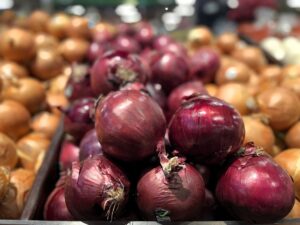
I moved to the red onion bin, gazed at the enormity of the purple bulbs, and wondered, “When did these get so big?” I only needed a red onion of regular size for my recipe, but all I saw in the bin were giant onions. I rustled around in the bin looking for a “smaller” onion, and I thought I found one, but it tipped the scale at just a small mark above one pound (.45 kilograms). “ Isn’t there one smaller?” I asked as I continued my marauding. I thought if I used one of the larger onions in my stew, it would be an onion stew rather than a lamb stew. By my calculations, instead of complementing the lamb, the stew would become overpowered by the flavor of the pungent orb. I continued my search to find one of normal size, but to no avail. I eventually gave up and decided to go with the first “smaller” onion I found.
A similar scenario occurred at the bell pepper bin. Each pepper was a dark, sultry green, about the size of a baby’s head. A baby’s head! Yes, that big! No regular-sized bell pepper was found. So, baby’s head it was.
I went to pick up an orange for breakfast. Same thing. The seductive color of the uniformly perfect fruit was tarnished by the fact I couldn’t find one under a pound (.45 kilograms). I can’t eat that much orange in a single sitting. When did all the produce become jumbo-sized?
Like, what the fuck?!
Stew Time
After my purchase, I drove home and realized the gleam I had in my eye for the beautiful fruits and vegetables when I first walked into the produce section had lost its luster. I realized all the produce I picked up was too large. The oranges and apples, a pound each; the red softball of a tomato was the size of … a softball; the cabbage, a rich light-green bowling ball, etc. etc. Did I shrink? Or, did I somehow get transported to a planet of giants? Did Jack in the beanstalk feel like I did?
Once home, I began making my stew. While taking out the huge onion and bell pepper, I imagined them as a couple of bullies, beating up the lamb until the stew tasted only of vegetables.
The recipe called for one red onion and one bell pepper. I assumed it meant normal-sized. So, I chopped up half of each of the monstrosities I had and threw the colored squares into the pot with the rest of the ingredients. I wondered if that would be too much of the spicy victuals, but I set the cooking timer anyway.
Eating the stew at dinner, to my surprise, I noticed it was a little bland. I didn’t recall it tasting this underwhelming the last time we ate it. The pot-au-feu was way more watery than I remembered. Did I fuck up the recipe?
After cleaning up, I checked the recipe and was reassured that I prepared the lamb stew as instructed. “What is going on with my stew?” I asked myself.
The next day I was with my friend who always shops at farmers markets. I shared what happened with the stew, and she explained that supermarket vegetables just don’t have the flavor they used to.
Since then, I have done some research, of course, and a story about an onion named Onion and a bell pepper named – you guessed it – Bell, arose. I am going to tell you about the story of Onion’s and Bell’s friendship, but before I get to them, I wish to share a few other tidbits about these jumbo produce items.
Why Lauren Has It In For Jumbo Produce
At the supermarket checkout station, it becomes apparent to me that those extra-large fruits and veggies actually cost more than regular-sized produce. Yes, that 99¢ a pound (.45 kilograms) seems like a deal, but it adds up when each single item weighs double what it should. And, I have to throw out half of that onion and half of that bell pepper because they have gone bad while waiting for me to make another stew. Now, they hold up my carrots! And bully my lemons. Can’t have that in my refrigerator! So, I have to waste ’em.
Anyway, those humongous items of harvest not only cause me to waste food, but they’re also making me waste money. And that, does my heart and my bank account no good.
Through my research, I have found out why my lamb stew seemed lackluster when I last made it. Apparently, jumbo-sized fruit and vegetables from supermarkets have less flavor and nutrition than their smaller brethren.
Ok, now we get into Lauren’s sources…
Now We Know What Happened to Lauren’s Stew
On 1 February 2024, L Valeriote posted an article on FoodRepublic.com entitled “Why Extra Large Vegetables Are A Red Flag At The Grocery Store.” In the article, she explains that:
“Extra-large vegetables may have been pumped up with an excess of water, resulting in a bland flavor and unpleasant texture that may be watery or fibrous.”
That explains my watery, flavorless stew!
She goes on to share that larger veggies also have fewer vitamins and minerals per bite.
Wendy Leigh’s article concurs with L Valeriote’s. Posted on TasyTable.com on 29 January 2026 and titled, “Why Those Jumbo-Sized Vegetables In The Grocery Store Should Ring Alarm Bells,” Wendy’s article explains why extra-large produce has flavor and nutrition problems. She notes that large industrial farmers interfere with the plants’ growth cycles by overwatering and overfertilizing. This makes them less flavorful because they contain more water, which dilutes the flavor and nutrients.
Onion’s and Bell’s Excellent Adventure (or, their trip to my stew)
So, back to Onion’s and Bell’s friendship and their trip into my stew. They grew up on separate farms, many acres apart. These farms were huge (thousands of acres) and monocultural. Imagine square miles of only one type of plant. Onion and Bell each were bred and raised to be big, to be colorful – and I don’t mean their language – and to survive long truck rides. They received an over-indulgent amount of fertilizer and water. They had pesticide showers to keep damaging critters off of them. Consequently, they grew up fast and big. One day, a loud machine came by and scooped each one off their home stem.
Bell ended up on a huge pile of other extra-large bell peppers. And several acres away, Onion was on a pile of overfed onions.
Bell and their pile were dumped into a large building, where they were rinsed and a thin layer of wax was applied to keep their skin shiny. Bell saw other members of their botanical family jettisoned because they were not big enough or smooth enough or just not good-looking enough. Then, Bell was packaged up into a box and trucked off to a warehouse.
Onion had a similar fate, but without the application of wax.
The warehouse is where the two met. Through the holes in their respective boxes, they shared where they grew up (actually, their growing-up stories were pretty boring since Onion just had a bunch of onions around them and Bell just had a bunch of bell pepper plants around them). But, Onion and Bell instantly became friends. They were excited when they ended up on the same truck bound for the grocery store 600 miles away.
Once in the store, they were unboxed and stacked neatly with other large produce that looked just like them: Onion with the onions and Bell with the bell peppers. Almost like home, but much more crowded. Bell couldn’t recognize Onion in the pile of other onions because they all looked alike. It wasn’t until they were in Lauren’s cart that the friends were reunited.
From there, we know the rest of the story: big parts of each ended up in Lauren’s waste bin.
Similar stories to Onion’s and Bell’s can be found in several articles, including the USDA’s and the Congressional Research Service (CRS)’s publications on U.S. fruit and vegetable supply chains.
Onion’s and Bell’s friendship was not formed in the field, but when they were in the supply chain. The supply chain is the logistical system designed to consistently package and deliver produce from large industrial farms to processing plants to large supermarket chains on a predictable schedule. And, those grocery chains want perfect, uniform-looking produce that’ll entice customers to purchase too much food.
Fred Meyer is a store chain in the U.S. Pacific Northwest owned by Kroger, the 6th largest grocer in the world, according to the article titled “Top 10 Largest Supermarket Chains in the World,” by Kirti Sharma, posted on 29 Dec 2024 on JagranJosh.com, At one of the Fred Meyer locations in Seattle, Lauren interviewed a produce manager. She isn’t publishing their name because she didn’t ask for permission to do so. She’ll do better in her next interview.
Anyway, this produce manager confirmed that the store was only concerned with the dollar value in the customer’s basket at checkout, and the jumbo-sized produce is simply a way to increase that dollar amount.
The produce manager also explained that the season and weather can affect produce size. Farming companies will overwater to get their produce to grow faster so they can meet their delivery date targets before bad weather sets in. This increases the size of the produce as well. The store tries to “flip” product as fast as possible and is only concerned with having something that sells. Show me the money!
The Impact of Jumbo-sized Produce
Onion and Bell would not have become friends if they were not part of the supply chain: large industrial farming, to large industrial processing, to long-distance trucking, to a large grocery store chain’s supermarket to my stew pot.
There are some ramifications of this large commercial supply chain operation. Those include, but are not limited to:
- Increased food waste
- Environmental degradation
- Less choice for consumers
- Decline of small family farms
- And, as discussed a bit earlier, less flavorful and less nutritious food
Food Waste
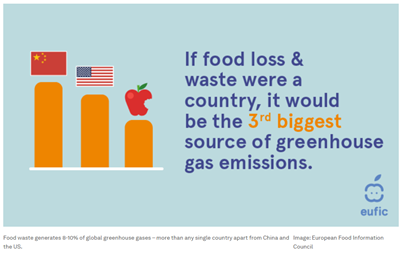
Food waste is a global problem. Wasted food is one of the largest contributors to global greenhouse gas emissions. As Simon Read explains in his 2 September 2022 article for the World Economic Forum, “Vegetables are changing shape because of the climate crisis.” He states that,
“If food loss & waste were a country, it would be the 3rd biggest source of greenhouse gas emissions.”
Eight to 10 percent of global greenhouse gas emissions are due to food waste, per a U.N. Climate Change news blog article titled, “Food loss and waste account for 8-10% of annual global greenhouse gas emissions; cost USD 1 trillion annually,” dated 30 September 2024.
As waste, Onion and Bell are more powerful than we thought.
Unfortunately, the large grocers don’t always think about the waste that their shoppers create when they have to buy such large-sized produce. When asked about whether they think about the waste at the consumer level, my Fred Meyer produce manager interviewee responded that they were,
”… not concerned about the customer side of waste.”
According to estimates from the EPA and the United Nations Food and Agriculture Organization, about 14% of all food produced is wasted before reaching the store! But, 11% is wasted in our homes, says Trishita Deb in her article on Media.market.us from 30 January 2026, “Food Waste Statistics By Household, Retail, Solutions (2026)“. 11% is not insignificant. And, the jumbo-sized produce trend makes that waste pattern harder to curb.
Environmental Degradation
Big industrial agriculture contributes to waterway pollution, consumes vast amounts of clean, fresh water, and degrades soil, leading to erosion. Large industrial farms use phenomenal quantities of fertilizers and pesticides to grow vegetables to the jumbo-sized specs ordered from the grocery chains. All that water and those chemicals are like steroids for the plants, but they also contribute to pollution problems and create other concerns not addressed in this article.
Volumes have been written on the topic of environmental damage from these large farming operations, including by the USDA and USGS.
For example, per James M. McDonald’s analysis of U.S.D.A. data in his article “Consolidation in U.S. Agriculture Continues“ posted on 3 February 2020 on the USDA’s ERS web blog, “Amber Waves:”
- 80% of all water consumption in the United States is from farm usage
- 41% of all farmland is operated by large farms
- and doing the math – oh no! not the maths – we can calculate that about a third of all water consumption in the U.S. is by large farms.
And the pollution created by these farms is huge. Several articles show that pollution from farm runoff is occurring and is significant. Perhaps the best example, though, is the United States Geological Survey (USGS) stating:
“Agricultural chemicals move into and through every component of the hydrologic system, including air, soil, soil water, streams, wetlands, and groundwater.”
This, from the USGS’s report “Agricultural Contaminants,” published 1 March 2019 by the Water Resources Mission Area.
Limited Choice for Consumers
Now, limited consumer choice might not sound like a big deal. But consider this scenario: you don’t like how that softball-sized tomato tastes and want to try another variety? Well, too bad. The supermarket sells only that variety of red tomato as large-sized, flavorless, and nutritionally void that it is.
Ditto Onions.
Ditto Peppers.
Etc.
That is not a scenario most people would prefer. What if the grocery store company and the supply chain decide red onions aren’t profitable enough and stop producing and selling them? How will Lauren make her killer lamb stew? Those yellow onions just won’t cut it! And having only a choice of jumbo-sized varieties, with their subpar flavor and nutrition profiles, is not really a choice. Especially if a cook throws away a good amount because it is unneeded.
Decline of Small Family Farms
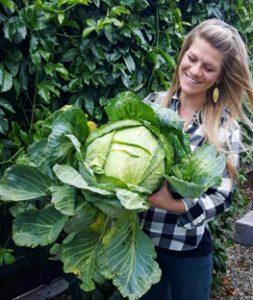
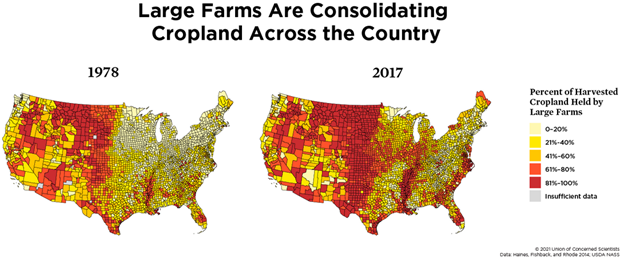
The demise of family farms may not be a topic that comes up around the dinner table, but Lauren thinks consumers should at least consider the impact of consolidating smaller family farms into large-scale farming operations. Yes, we like to see pretty produce and are seduced to purchase a cabbage that can feed a small village, but as the supply chain is controlled by larger and larger entities, all the negative impacts discussed here, and other issues beyond the scope of this blog post, will grow and become more entrenched: less choice, more pollution, and eventually, higher prices.
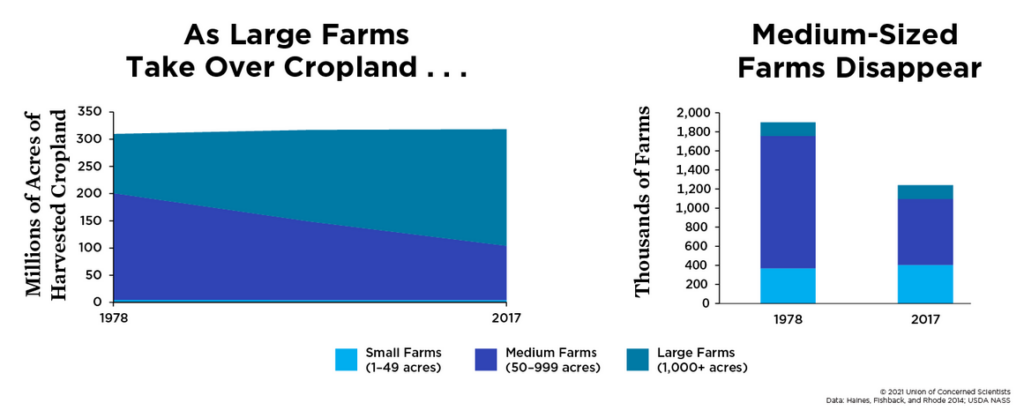
What effect will the loss of family farms have on rural communities? “Bigger Farms, Bigger Problems” is an article published by The Union of Concerned Scientists (UCS) on 14 April 2021 on their website. The article explains that farm consolidation creates barriers for new farmers and for those from underrepresented groups. Along with those barriers, small farm consolidation hollows out U.S. agricultural communities, undermining the more equitable distribution of income, eroding local economies, and weakening the social fabric of those communities. Lauren doesn’t think the consequences of such activity will be a positive.
Back to Our Kitchens
Ok, Lauren, how (and why) did your rant on over-sized produce get into the state of family farms?
Because, it is one of the reasons we have large produce that is neither tasty nor nutritious, increases waste, and costs me money!
Throwing out produce is a waster of money. And, larger produce, mostly due to large industrial farming practices such as over-watering and excessive fertilization, produces less flavorful, less palatable, and less nutritious meals.
Wendy Leigh, in her TastingTable.com article, gained insight from Jane Olivia, a nutrition-based holistic private chef in Arizona. Jane explains that the fast-growing methods for producing jumbo vegetables can dilute their flavor and affect their texture. And in her FoodRepublic.com article, L Valeriote points out that like Onion and Bell, and their huge friends may look great, but they aren’t necessarily as healthy as they look due to their diluted nutrients.
Oh, my god, Lauren. You are such a downer! Now that you have us all depressed, what are we supposed to do about these wicked, jumbo-sized fruits and vegetables?
What You Can Do About It
When in Europe, I always enjoy the produce. The oranges in Lisbon are sweeter than their softball-sized, watered-down, and less flavorful U.S. brethren. The onions in Paris are more compact and more spicy than their huge U.S. counterparts. The tomatoes in Florence aren’t mushy or too liquidy. They taste like a robust sunny spring afternoon. This isn’t by chance.
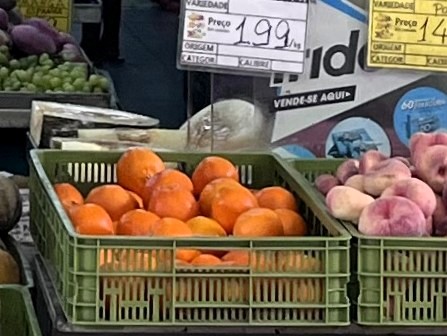
The food is more delicious and nutritious in Europe because it is produced locally. Most of the produce is not as pretty as, nor as big as, that in the U.S. Unfortunately, this is changing in some of the larger grocery chains. But, by and large, though, the produce is mostly from local farmers. And, stores in France want to keep it that way, as explained by TheTimes.com article entitled “French stores ban winter strawberries — but is it just a fraise? by Adam Sage, posted on 8 November 2024. Intermarché and Netto, owned by Les Mousquetaires, want to keep winter strawberries out of their stores. They are wanting…
“…to reduce greenhouse gas emissions and to promote seasonal locally produced fruit and vegetables”
as opposed to importing mostly from Spain and Morocco.
Shop Small
So how can you cook with and eat more flavorful fruits and vegetables?
Well, Haley McNamara has some ideas. In her article of 27 June 2025 on the TheTakeOut.com, “Why Those Jumbo Sized Veggies At The Grocery Store Are Actually A Red Flag” shares some tips. One is not to overlook the smaller, more “normal-sized” products. Pick the smaller, sweeter carrots. Select the onions that are only 2 to 3 inches (5 to 7.6 centimeters) round, rather than the 4 – 5 inches (10 – 13 centimeters) of the jumbo ones. She doesn’t say the following, but Lauren shall: avoid the bell peppers that are the size of a baby’s head, or the softball-sized oranges. Neither tastes remotely close to how good they look.
Rummage in the produce big, to see if you can find the “normal” or even the “smaller” sized item hiding under the larger. Or check out the bargain bin. Sometimes the small ones get placed there at a discounted price – bonus!
Go to a Farmers Market or Go Organic
Haley also suggests shopping at a farmers market. Most farms represented at a farmers market are small farms where the farmers don’t use high-pressure tactics to force Onion and Bell or other produce to quickly grow exceedingly large.
If a farmers market isn’t nearby, the organic section in the grocery store tends to carry more reasonably sized items, albeit at a bit higher price. However, if you don’t buy more than you need, they may end up being a bargain as you’ll waste less food.
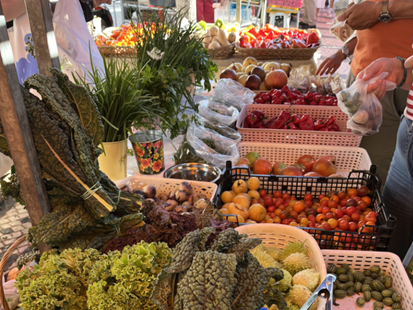
Another advantage of farmers market is that size doesn’t really matter – at least when it comes to produce flavor or nutrients. If the farmer isn’t using farming practices of the big commercial farms, the produce is grown in healthy soil without large inputs of water and fertilizers, and the product is allowed to grow at a more natural pace, that 12-inch carrot will be sweeter and more nutritious than its grocery store counterpart. The onion more pungent, the orange more sweet, and the broccoli less bitter – unless she just broke up with her cheating cauliflower partner.
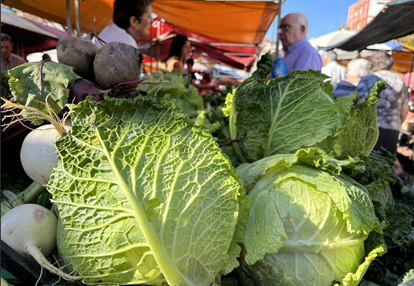
Like in Europe, most produce at a farmers market is grown locally, which also reduces transportation costs and the associated pollution.
Cook Those Jumbo Veggies
If someone else has already picked through the bins and snatched all the smaller produce, and there is no organic availability or no direct-from-farmers options, all hope is not lost. The monstrosities can be cooked, but in a different manner than smaller produce. After cooking, they can be frozen and then used on a future date by thawing and reheating.
Onion and Bell like to be placed in a warm bath of some kind of soup broth. Or, they enjoy being roasted on a cookie sheet drizzled with olive oil and seasoned with salt, pepper, and Italian seasoning. Carrots roasted after being rolled in brown sugar can regain their sweetness. Or a few drops of Tabasco hot sauce in the soup will punch up the missing flavor from oversized Onion, Bell, Mr. Huge Carrot, and Miss Jumbo-sized Celery. Soup is a great way to cook out the extra toughness in Vegetables of Incredible Size. Roasted veggies and soups are easy to freeze. Then, with a quick microwave reheat: voilà, a quick side dish for lunch or dinner. No throwing half an onion or bell pepper away!
That’s all good for returning flavor and removing toughness from overgrown vegetables, but what about fruit, Lauren?
Well, I like baked apples. Cored and filled with butter, cinnamon, and sugar, then baked in the oven. Perfect for the less-than-flavorful apples the size of a small dog. Or, make a fruit salad with those not-so-sweet orange globes. Throw in some grapes, yogurt, and chopped mint to make up for what is missing flavor-wise. Maybe add walnuts or pecans for added texture.
Be creative, but adding jumbo-sized, low-flavor produce and then adjusting the recipe might be tougher for some recipes than others.
Reduce Food Waste
There are companies that now deliver groceries that might have ended up on a farm’s waste heap because the produce didn’t fit the grocery store model of good fruit. MisfitsMarket.com and ImperfectFoods.com are sites owned by the same company. They offer delivery for “ugly” produce and other imperfect groceries, therefore reducing the waste from the rejection pile at the processing plant. Those “ugly” fruits and vegetables typically are not of an incredible size, so you won’t waste a good portion of them at your place, either.
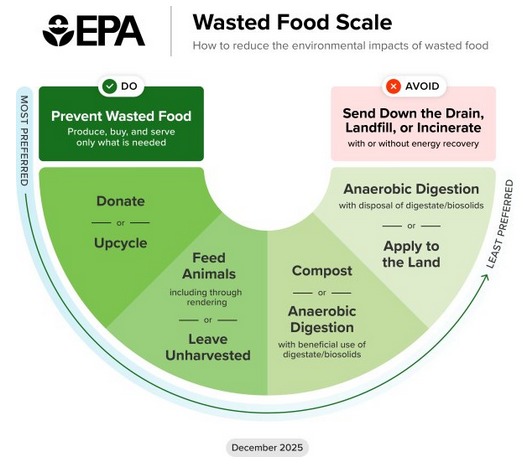
The EPA provides ideas to reduce food waste on their Reduce, Reuse, Recycle blog post titled “Preventing Wasted Food At Home.” Ideas to reduce food waste include planning out meals and sticking to your shopping list. Those actions help the shopper purchase only the amount of food they need. In addition, shopping when not hungry will help consumers avoid impulse buys.
Portion control. Cooking smaller portions can help to avoid leaving uneaten food on a plate, which then gets scraped off into the trash.
Freezing food before it spoils is a good storage strategy. The food is then available to thaw as needed. Tip: freeze the excess food in smaller amounts. This helps prevent thawing out too much food, which has the potential to become waste, defeating the purpose of freezing extra food in the first place.
And consider sharing excess perishables (before they go bad, of course) with the local food bank or with other community members.
These ideas, and more, are available in the EPA’s article. They even have a tool kit to…
“…help you figure out how much food is really going to waste in your home…”
Grow Your Own Meals
Yes, become your own farmer! Well, in the city, I think it’s called gardening. But, growing one’s own produce can be not only a great way to get the freshest fruits and vegetables, but also means not having to give as much money to the food industrial complex that creates those monstrous onions, bell peppers, cabbages, etc. Plus, gardening is a good excuse for getting outside when the weather is nice.
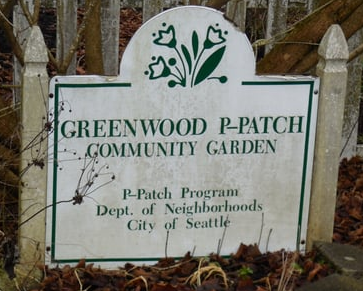
If you have limited space or live in a multi-family building, several cities – maybe yours – have urban community garden programs for neighborhood gardening.
Let’s Sum It Up
In summary, Lauren now sees oversized produce as the end result of a large supply chain designed to get her to spend more money on groceries than need be.
Onion and Bell are pretty and big and might be friends. But, like their other friends: Orange, Apple, and Tomato, their value is an illusion because their flavor and nutrition are lacking. Additionally, they contribute to Lauren’s food waste because they are more than she needs for her recipes and they go bad before she needs them again for another meal.
Large-scale farming grows most of the jumbo-sized produce found in big grocery chain stores. These large-scale farms:
- consume 30% of the U.S.’s water
- pollutes the watershed, and
- deplete soil nutrients and subject the soil to erosion.
Up to 40% of food produced in the world is wasted. 11% of food is wasted by households. Food waste produces 10% of the world’s greenhouse gases. To reduce her personal waste, Lauren tries to:
- plan meals – which usually doesn’t involve buying jumbo-sized produce
- properly store food
- freeze extra food, if viable.
To regain flavor and nutrition in her produce, Lauren attempts to:
- shop at farmers’ markets
- look for smaller-sized items in Walmart, Vons, Kroger, or any supermarket in which she shops
- grow her own produce, when possible.
- And, if that all fails, she’s gonna cook the shit out of the bastards. She’ll freeze the leftovers for defrosting later.
Hopefully, you will find these ideas helpful in purchasing the right-sized produce for you. May your fruits and veggies be full of flavor and nutrients.
How Do You Do It?
How do you use jumbo produce? How do you handle food waste? What do you think of the ideas we offered in this article for dealing with large-sized produce? Drop us a note. Go to the Contact page and fill out the form. You can also let us know what you thought of this post overall and provide ideas for future posts. Or, just say “Hi!”
Coming Up
Coming up next we’re talking about sweaty sheets. Not because of fun – does your mother know you have such a filthy mind? – but because of Hot Flashes. Have you ever been in a business meeting and then your body decides to set itself on fire? How are you supposed to present your product plan to your boss when all you want to do is strip off your blouse and jump under a cool shower? Hot flashes, like WTF?!
No, you are not imagining the heat. Perimenopause and how it affects mind and body. Coming in the next couple of weeks.
Thank You! Send Us a Note!
Thanks for spending time to read this post. If you have feedback, article ideas, other suggestions, or just want to send us good karma, go to the Contact page and send Lauren a message. If you are gonna troll, though, just fuck off.
Peace, love, and happy tastebuds to everyone! ✌️ ❤️
Lauren
Links
https://www.tastingtable.com/2084087/large-vegetables-grocery-store-red-flag
https://www.foodrepublic.com/1501629/large-size-vegetables-red-flag-grocery-store
https://www.thetakeout.com/1891764/large-sized-veggies-grocery-store-red-flag
https://www.epicurious.com/expert-advice/bigger-vegetables-better-than-small-article
https://www.weforum.org/stories/2022/09/food-waste-climate-drought-farmers
https://www.ucs.org/resources/bigger-farms-bigger-problems
https://media.market.us/food-waste-statistics/
https://seametrics.com/farm-water-facts
https://www.chesapeakebay.net/issues/threats-to-the-bay/agricultural-runoff
https://www.usgs.gov/mission-areas/water-resources/science/agricultural-contaminants
https://htt.io/learning-center/water-usage-in-the-agricultural-industry
https://www.ers.usda.gov/topics/farm-practices-management/irrigation-water-use
https://www.epa.gov/international-cooperation/international-efforts-wasted-food-recovery
https://www.epa.gov/recycle/preventing-wasted-food-home
https://www.fda.gov/food/consumers/how-cut-food-waste-and-maintain-food-safety
https://www.ers.usda.gov/amber-waves/2020/february/consolidation-in-u-s-agriculture-continues
Leave a Reply