
Update: 2026-03-10
The Heat
I have a friend named Jessica. She works at a tech company and frequently gives presentations to stakeholders on her products’ results and plans for future versions. Some of those meetings include her boss.
Occasionally, her boss’ boss attends. Invariably, in the middle of her presentation, it feels as if someone turned the heat in the room to the max. She knows that didn’t happen, because everyone else is sitting comfortably in their jackets and sweaters.
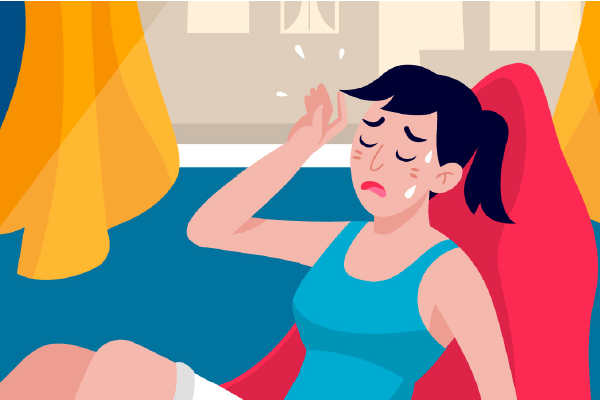
She can feel her ears turning embarrassment red as they are set ablaze. Perspiration forms on her forehead and upper lip. She feels a tickle from beads of sweat running down her back. Her heartbeat is racing, with adrenaline surging through her shaking hands.
Her mental acuity is stale and processing anything –especially questions from the audience, i.e. her boss’ boss– is challenging. She’s asked about the expected ROI, and if she is tracking to target. Jessica has no clue, despite her crazy analysis the night before. Market penetration? Resource costs? She can barely recall the numbers, despite knowing them inside and out minutes before the meeting.
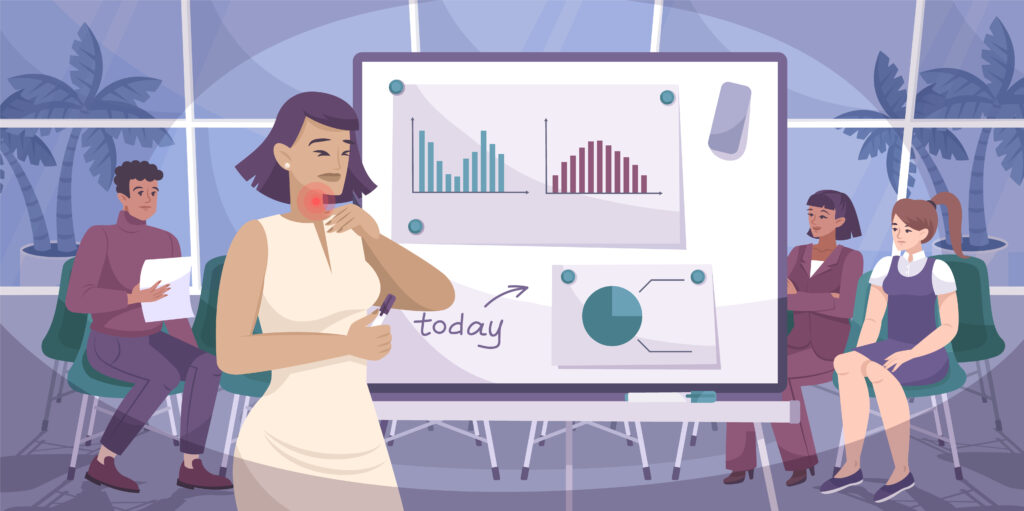
How is she supposed to present her product plans to her boss when all she wants to do is strip off her blouse and jump into the fountain outside the conference room window?
After about 8 minutes, she feels as if the furnace, which had been in overdrive only minutes before, has now reversed course and turned the room into a refrigerated food locker. She shivers from the chills. And then after the meeting, her ears that had been in flames, itch now something fierce.
This occurs three times over a couple of months. Jessica blames it all on public speaking jitters that people in general experience when presenting to their boss, or their boss’ boss.
Her therapist, a man, suggests she is experiencing anxiety attacks and prescribes her a pill to take before each meeting to see if she experiences the problem again.
These “attacks” continue to occur almost every time she presents. Dumb pills. Don’t work. And, her itchy ears are driving her mad.
One Saturday morning, she is in the freezer aisle at the local Fred Meyer, right between the frozen peas and the frozen pizzas. No boss in sight. Panic rises along with the heat moving up from her chest. The fever moves up to her cheeks and to the top of her head. Her ears are on fire. She feels as if her touch will melt everything in the freezer. Jessica abandons the cart in the middle of the aisle.

She tears off her hoodie as she heads outside. Thankfully, she has a cami underneath. Outside with her coat and hoodie in one hand, and her purse and car keys in the other, she begins to cool off. Eventually, she finds herself shivering in her car in the parking lot. While gasping for breath, she realizes she can’t remember the way home. Jessica continues to sit in the car with the motor running. “When did I turn on the car?” she thinks. A few more minutes and her body returns to “normal.” Now that the “episode” has passed, she decides that returning to the store and completing her grocery shopping is too embarrassing. Raisin Bran will be fine for dinner tonight. She plans to come back and shop for groceries tomorrow. Thank the goddess that her memory for the way home returns.
Jessica finally schedules an appointment with her doctor, a woman. It becomes imperative after she hasn’t had a good night’s sleep in weeks. She’s been waking up in the middle of the night to damp sheets and wet pajamas. Hey reader, get your mind out of the gutter. It wasn’t because she was having fun with someone, as much as she wished that were the case. Too often, she goes to bed alone! She thinks she is having nightmares and doesn’t remember them upon awakening. And her ears itch like crazy. She can’t scratch them enough to gain any relief. After talking with her doctor, it is evident she is not suffering from night terrors, but from something else.
Her doctor says, no, she is not imagining the heat. She has all the signs of suffering from hot flashes. Most likely from her hormone levels being out of whack due to perimenopause. And, that’s probably why her ears itch, too! Jessica thinks:
Wait. Hot Flashes. Menopause, Me? Like, What the Fuck?!
Not Menopause. Perimenopause.
This story is an amalgamation of several women’s experiences. The major characters are:
- Jessica – she is the literary creation Lauren uses to blend various women’s experiences.
- Who the fuck is Lauren? – She’s the author of this article.
- Pam – a friend of the author (Lauren). She appears later in the narrative, along with…
- Susan – a made-up friend of the author that she writes to in an effort to add dimension to the story. Sometimes Susan writes back.
Except for the author of this article and the authors of the referenced articles, the names have been changed to protect the guilty.
Okay, disclaimers are all done. Back to our story.
Pam is a friend of mine, and when I shared with her about Jessica, she wrote to me that, “Menopause is the biggest piece of shit ever invented!!!!” I think Pam might also suffer from Tourette’s.
I just had to share her response. But we are not discussing menopause. We are discussing hot flashes during perimenopause.
Ok, back to Jessica and her doctor’s appointment, where she learns that what she is experiencing are hot flashes. Jessica’s immediate reaction is: “I can’t be having hot flashes, I’m too young for menopause.”
Most of us may know about hot flashes during, and sometimes after, menopause, but before? Yes, Susan, years before menopause, perimenopause can begin.
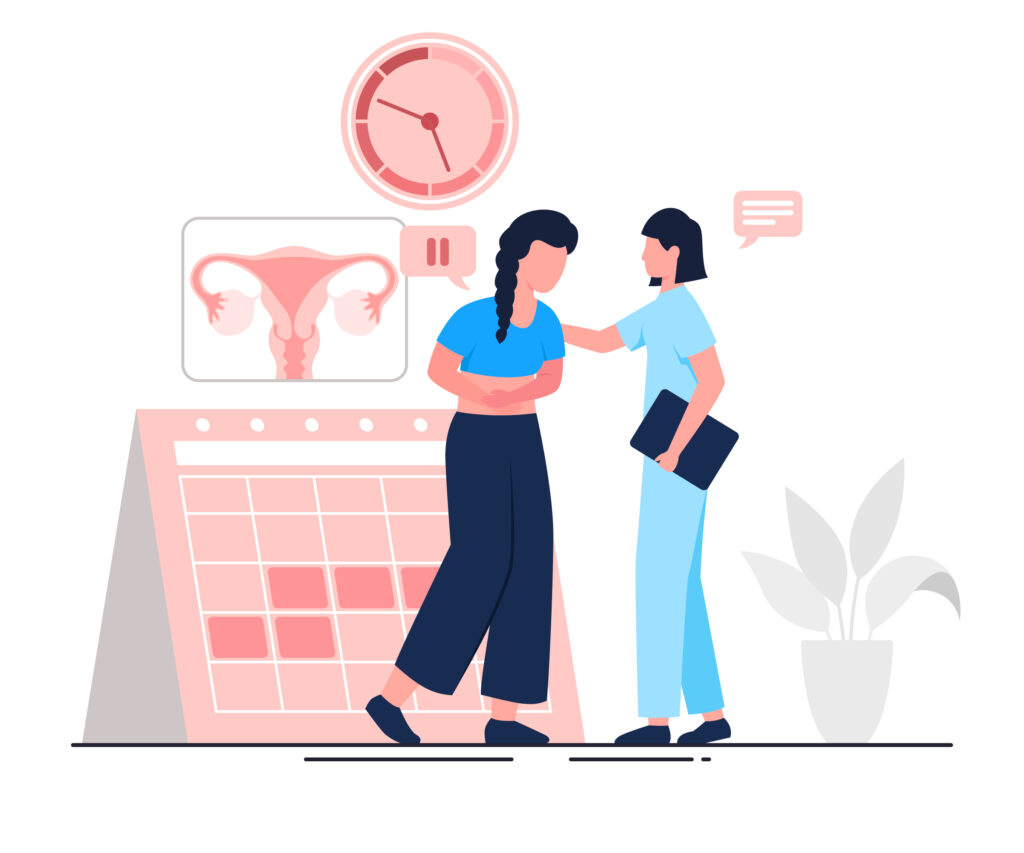
Jessica’s doctor explains that she read a post on the Association of American Medical Colleges website, AAMC.org, News Blog, “Women are changing the face of medicine in America,” stating that 2/3 of Ob/Gyns are women and over half of all U.S. medical students are now women. This might or might not be related, but women’s health issues, such as perimenopause, seem to finally be getting their medical research due.
From just that type of research, we have an article by Drs. Ramandeep Bansal and Neelam Aggarwal, entitled “Menopausal Hot Flashes: A Concise Review,” published in the 2019 Jan-Mar 10(1) issue of “Journal of Mid-Life Health,” The good doctors inform us that 80% of women experience hot flashes during menopause, and 55% of women experience hot flashes in the time leading up to menopause. Perimenopause is the period of time that begins with “menstrual irregularity” and ends with menopause.
As explained by a blog post on Hormonally.org, entitled “Perimenopause and Menopause: Everything you need to know,”
“…many people experience menopausal symptoms for years before their periods completely stop. This time in your life is called perimenopause.”
So, as was explained to her by her doctor, Jessica isn’t in menopause but is in perimenopause. Menopause is years down the road for her, but she gets to enjoy hot flashes along the way. Lucky Her. Eye roll emoji here.
Hot Flash Symptoms
Okay, in order to understand hot flashes and how to deal with the symptoms, let’s define what a hot flash is and what it is not.
In medical terms, a hot flash is called Vasomotor Symptoms (VMS). Gynecologist Oncologist Soheila Aminimoghaddam and Nastaran Abolghasem, in their article “A Review of Management of Perimenopausal Hot Flashes,” in the March 2019 issue of Journal of Obstetrics, Gynecology & Cancer Research (JOGCr) define VMS as:
“…subjective feelings of heat accompanied with cutaneous vasodilation.”
Wow. I had to look up “cutaneous vasodilation.” Even Dictionary.com didn’t have a definition. I ended up going to the google. It provided several sources. From those sources, it summarizes cutaneous vasodilation as blood vessels in the skin expanding in diameter. Hrmm. Thinking emoji here.
Drs. Aminimoghaddam and Abolghasem explain that a hot flash is a sensation of heat and intense sweating that occurs occasionally for many perimenopausal women, mostly on the chest, face, and neck. Additionally, they point out that heart palpitations and anxiety often accompany hot flashes.
My friend Pam explains hot flash symptoms like this:
- During stressful times, you are guaranteed to humiliate yourself publicly by turning beet red & tearing your clothes off.
- You never know which of your personalities will surface or when.
- You have less than NO filter.
- When you have a hot flash, you strip publicly & don’t give a shit about who sees what.
Hot flashes are not a psychological problem. Although Pam can make a compelling case that they might be. The reasons for hot flashes are physiological, believed to be triggered by hormonal fluctuations that cause the body to overreact to small increases in core body temperature. That overreaction can also include additional anxiety.
So, Susan, you are not paranoid. You are just experiencing Hot Flash Anxiety. But, then again, maybe…
Who typically gets Hot Flashes ?
Anyway, as Drs. Bansal and Aggarwal inform us from their concise review article on hot flashes that 55% of women in perimenopause report having hot flashes, but as those women get further along in their transition and closer to menopause, the percentage of women who experience hot flashes increases.
So, Lauren, how much time are we talking about?
Okay, okay. We’ll get to “Intensity, Frequency, and Duration” in a moment, but right now, to address a few things about who gets hot flashes…
Per an article in the Harvard Health Publishing, Harvard Medical School by Nancy Ferrari, dated 14 August 2020, entitled “Menopause-related hot flashes and night sweats can last for years” women with a higher BMI (overweight), who currently smoke or are ex-smokers, or who are experiencing stress, tend to have hot flashes for a longer period of time than their sisters. Having anxiety and depression are factors, too.
Now my friend Pam wished to explain that what the Harvard study didn’t explain was her experience during menopause and hot flashes:
- Hot flashes suck!
- EVERYONE & EVERYTHING annoys you.
- You crave sex, but your husband stops putting out.
- So, then you fantasize about all the ways you can rid him of his useless parts.
- Your bladder decides to play ‘fragile,’ so you become prone to peeing your pants when you laugh, sneeze, or cough.
- When you figure that out, you preemptively find yourself doing crossed leg contortions & either falling off chairs or falling down on the floor before laughing, coughing, or sneezing.
- You never know when you are done with menopause because as the years go on, she lies dormant for varying time frames & then the BITCH resurfaces when you least expect it!!!!!!
Did I mention Pam may have Tourette’s? Other than the last item, the other things on Pam’s list seem to be the normal day-to-day for me. But enough of Pam, back to the Harvard paper and SWAN.
The Study of Women’s Health Across the Nation (SWAN) is cited in the article and shows that ethnicity also plays a role in the duration of hot flashes. African-American women had the longest duration of having hot flashes, while Japanese and Chinese women reported experiencing them for half as long.
Drs. Bansal and Aggarwal also identify in their article the when and how different groups of women experience hot flashes. For example, Indian women experience menopause for up to five years earlier than women from the West. As such, they concluded that Indian women might be experiencing hot flashes at a younger age. Geographical boundaries also appear to have an influence. 97% of Turkish women report hot flashes, while only 45% of women in Asia experience hot flashes. North and South American, European, and Australian women stated percentages of experiencing hot flashes are between these two extremes.
At what age do most women start to exhibit symptoms of hot flashes? Of those who have hot flashes, they started as soon as their menstrual cycle became irregular. Missed periods fall into that category. This is according to the medically reviewed article on the Cleveland Clinic’s website updated on 21 October 2024, “Hot Flashes”
Another Cleveland Clinic article, updated on 8 August 2024, “Perimenopause,” states that perimenopause can start between mid-30’s and mid-50’s.
Simply put, hot flashes can present themselves at any time from the start of perimenopause. A woman older than her mid-thirties, who starts to skip her period, can potentially experience hot flashes. Other factors like weight, ethnicity, and smoking also increase the likelihood she’ll have them.
Now, what about how often someone can expect to have one of those hot flashes? Yes, Susan, that section is next.
Intensity, Frequency, and Duration
Well, the reported intensity of hot flashes spans the gamut, from just a bit uncomfortable for a few minutes to 10 minutes of sweaty, flames-out-of-the-ears, head-pounding hell, followed by chills worse than being in a snow blizzard wearing only sweat-soaked clothes. Most people experience an intensity somewhere in the middle: not fully debilitating (although it feels as such), but harsh enough to scare Dave from work to run out of your office.
Factors that can increase the chance of having a hot flash also affect the intensity. Being overweight is one factor. Being an American of African descent is another.
Similar to intensity, frequency is an individual thing. It spans from occasional to every fucking day. Jessica, like some women, only experiences hot flashes every few weeks with the occasional bout of night sweats. However, according to the Cleveland Clinic’s “Hot Flashes” article, up to 33% of women surveyed report experiencing more than 10 hot flashes per day. Yikes!
How long must we suffer?
We all ask, “How long will I have to endure having these hot flashes?”
Unfortunately, the answer is, “it depends.”
But, to give a sense of what you’re in for, Drs. Nancy E. Avis (PhD), Sybil L. Crawford (PhD), and Gail Greendale (MD) wrote in their article, in the April 2015 Vol 179, No. 4 of “JAMA Internal Medicine”, “Duration of Menopausal Vasomotor Symptoms Over the Menopause Transition”, as posted on the JAMA Network, state that the median duration of VMS was 7.4 years. For African-American women, the average timespan for experiencing hot flashes was 10.1 years! But, for all groups, other factors increased duration, including younger age at onset, lower education levels, greater stress, and symptoms of depression and anxiety.
Or, as my friend Pam points out:
“I would also like to point out that if men had to live through the torture of hot flashes, society would either end, or a cure would have been found by now. Note that they had no problem naming female torturous stages after themselves: MENSTRATION, MENOPAUSE, MENTAL illness!
Unfortunately, not only do women experience hot flashes beginning in perimenopause, and continue through the menopausal years, but as Pam previously so eloquently stated (tongue firmly in cheek), they can come back years after menopause is over, post-menopausal. Frustrating, ugh!
I am just thankful that, now, a large enough (and growing) percentage of doctors and medical students in the U.S. are women, and consequently, a lot more is being done for women’s health. Including the finding of causes and treatments for hot flashes.
What causes HFs ?
Thanks, Lauren, if I wasn’t depressed about hot flashes, I am now.
I know dealing with these monsters of sweats and chills is tough. However, there are treatment options, and we’ll get to them soon. But to treat hot flashes and their symptoms, we need to understand what causes them.
The exact mechanism of hot flashes is not fully understood.
Ok, this is funny. Laugh with me. I know I said we should know what causes hot flashes, and then in the next sentence, I say we don’t know what causes hot flashes. Ha, ha. But Medicine does know a lot. And, as women, we should know what modern medicine knows about hot flashes.
It wasn’t that long ago that women’s health issues were always playing second fiddle to men’s because the field was mostly made up of men. Consequently, they didn’t know, or didn’t want to know, the causes of hot flashes. At least now, as more women are filling the ranks of the medical profession, research is being done. Attention is being paid to the issue. And we owe it to ourselves to know what Medicine does know about this affliction that brings suffering to millions of people.
There are many hormones involved, but estrogen plays a starring role. As explained by Drs. Bansal and Aggarwal in their Journal of Mid-Life Health article, “Menopausal Hot Flashes, A Concise Review,” it is believed that as estrogen levels decline (as happens during perimenopause), the hypothalamus and other components of the thermoregulatory system are less able to function normally. They think that it isn’t just lower levels of estrogen, but the rate of decline that affects causation.
Drs Aminimoghaddam and Abolghasem mention in their JOGCr article that perimenopausal women tend to have a more limited comfortable temperature range, and when Jessica’s core temp rises a slight amount, about 0.4°C/0.72°F, -which her body will do when stressed like having to present to her boss’ boss- her thermoregulatory mechanisms seem to overreact and sound off a fire alarm telling her blood vessels to open wide in order to transfer that heat out through her skin. This creates Jessica’s hot flash. Then, after a few minutes of flushing her body heat, her body temp drops below normal. In combination with perspiration and sweat-soaked clothes clinging to her skin, Jessica gets the chills. But in most cases, her temp will then stabilize within a short period. Total time from hot flash to normality: 3 to 10 minutes.
Other hormones, such as her serotonin and endorphins, also decline, causing her other symptoms, such as mental fogginess and a feeling of panic, as examples.
Ok, Lauren. I get it. There is a medical basis for my hot flashes. I have hormones, they are declining, and my internal thermostat doesn’t like it. Got it. But, what can I do about it?
Well, Susan, the first step is to know what might trigger a hot flash, and then we can discuss treatments.
Just shoot me. Hot flash triggers
The Cleveland Clinic’s article “Hot Flashes” lists several triggers, such as stress, smoking, and drinking alcohol. Below is the list of triggers from the Cleveland Clinic, along with some Lauren commentary.
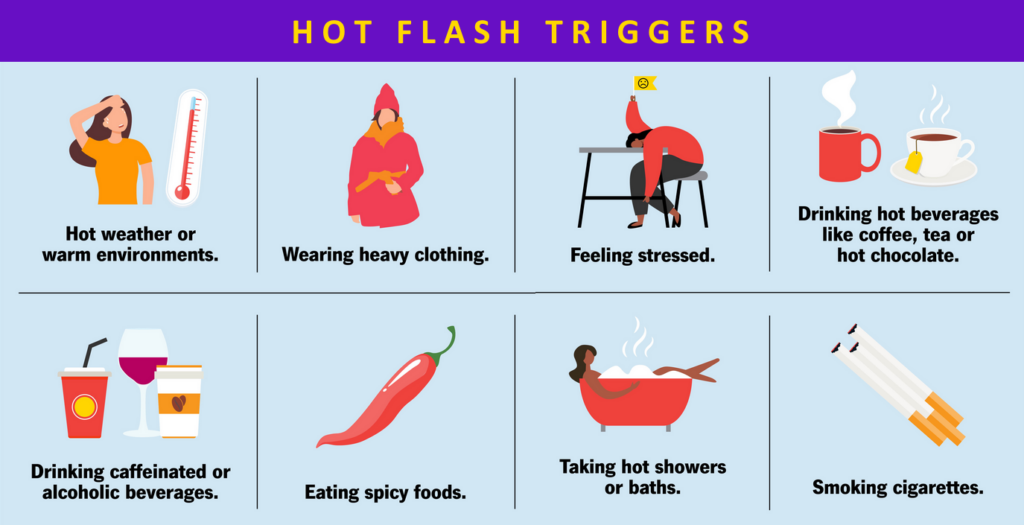
Common triggers include
- Stress. – No wonder Jessia always has hot flashes when presenting to her boss’ boss.
- Drinking caffeine or alcohol.
- Eating spicy foods. – It is with sadness that Jessica has to give up Mexican food with the hot salsa, or the sriracha on her Thai curry.
- Smoking. – One more reason to quit!
- Hot places. – Like Panama or Chicago in August. Or the thermostat is set too high at home.
- Wearing hot clothes. – That big, heavy winter coat might be too much.
- Drinking hot beverages. – No, no, not my coffee!
- Hot baths or showers. – These are favorites of Lauren, ugh! The price to be paid.
Great. Another list of things I shouldn’t do. Geez. Is there anything I can do? Why yes, Susan, there are a few things you can do to relieve some of the symptoms of your hot flashes. But, fair warning: more lists await.
What you can do about it
Drs. Bansal and Aggarwal, in their concise review of menopausal hot flashes, categorize hot flashes into three severities:
- Mild – no interference with daily activities,
- Moderate – interference with usual daily activities,
- Severe – usual daily activities cannot be performed.
When considering ways to manage hot flashes, severity is a primary factor. For example, when addressing mild severity, lifestyle changes can suffice for most sufferers.
Lifestyle changes
Nobody wants to change their lifestyle, but it can sometimes have an effect. You can’t prevent hot flashes, but these suggestions might reduce the frequency and intensity. They may usurp the need for a treatment method that requires trips to the pharmacy.
The Cleveland Clinic gives some ideas for lifestyle changes that include:
- Dressing in layers.
- Keep your home cool.
- Drink cold beverages.
- Use Cool compresses for when a hot flash strikes.
- Maintain a healthy body weight (BMI below 30, or ideally below 25).
- No smoking, or any tobacco or vaping products.
- Limit alcohol consumption.
- Exercise at least 20 minutes a day, in a cool environment – maybe a doctor’s office, they’re always cold (Lauren’s suggestion).
- Lighter sheets rather than a blanket when sleeping.
- Breathing exercises; Yoga; meditation.
In addition to these recommendations, Dr. Christine Maren, in her blog post of 23 December 2024, titled “Part III: Navigating Perimenopause: A Comprehensive Guide to Treatment Options and Lifestyle Strategies,” addresses perimenopause in general.
Her recommendations include:
- Eating more protein: 0.8-1g per pound (.45 kg) of body weight, at least 30 grams at each meal.
- Eating more fiber: organic fruits and vegetables.
- Balance complex carbs with protein and fat to help stabilize blood sugar levels.
- Limit sugar, alcohol, and ultra-processed food consumption.
- She also recommends exercise, choosing movements that energize.
- She believes in reducing the number of toxins in her life, such as harsh cleaning products and unfiltered water.
- Mindfulness, self-compassion, and self-care are ways Dr. Marin suggests to manage stress. Stress or not, these things help life go a lot smoother.
- And, Sleep. 7-9 hours a night. Progesterone at bedtime can help with falling asleep and with getting better sleep.
Sometimes, hot flashes are frequent or severe enough that they interfere with your life and fall into Drs. Bansal and Aggarwal’s moderate or severe category. That’s when it is time to go see your doc for additional treatment options.
Hormonal Treatments
Replace those hormones. HRT stands for Hormone Replacement Therapy. Like estrogen and progesterone, if you have a uterus. Or just estrogen if you don’t.
Another, newer treatment, involves taking estrogen and bazedoxifene –a selective estrogen receptor modulator (SERM). Regardless, see your doctor to decide which course might be the best for you in alleviating hot flash symptoms.
Dr. Christine Maren’s, article “Part III: Navigating Perimenopause: A Comprehensive Guide to Treatment Options and Lifestyle Strategies,” also explains which perimenopause symptoms can be affected by which hormones. This chart from Dr. Maren’s website can be helpful with addressing perimenopausal symptoms in general.
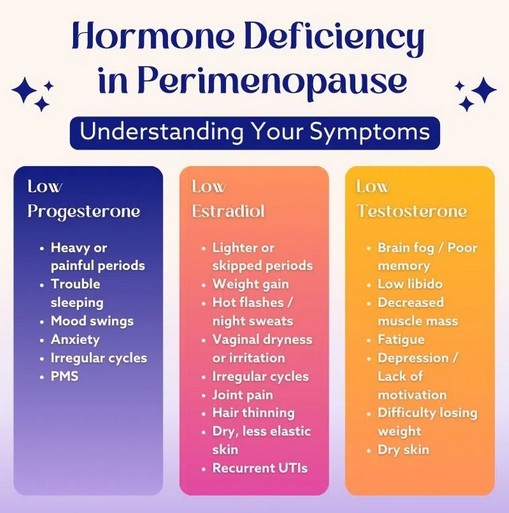
In terms of which hormonal treatment might work for you, again, discuss with your doctor, and they can also inform you about dosage and delivery method.
Medication, non-hormonal
The FDA has approved a few medications for the direct treatment of hot flashes. Fexolinetant and elinzanetant are FDA-approved, as is low-dosage of paroxetine, for the treatment of moderate to severe hot flashes. They work by targeting brain receptors and pathways involved in temperature regulation.
Another group of non-hormonal drugs, listed below, are medications mostly used for treating conditions such as depression and sleep problems. They are used “off-label” for hot flashes, meaning they weren’t necessarily approved by the FDA for the treatment of hot flashes, although they were approved as safe and effective against the original conditions they were designed to treat.

These medications can reduce the frequency and intensity of hot flashes. They include the following:
| • Venlafaxine (Effexor®) • Desvenlafaxine (Pristiq®) • Fluoxetine (Prozac®) • Paroxetine (Paxil®) | • Escitalopram (Lexapro®) • Citalopram • Gabapentin(Neurontin®) • Oxybutynin |
There are also some non-pharmaceutical “treatments” that include herbal supplements, vitamin and mineral supplements, and acupuncture. There have not been extensive studies performed utilizing herbal remedies. Of the few that have been done, they had significant shortcomings or have shown no effectiveness against hot flashes. Consequently, most experts do not recommend these courses of treatment, including:
| • Evening primrose oil • Soy • Vitamin E • Rhodiola • Collagen • B complex (Methylated) • Omega-3 faty acid • Resveratrol | • Black cohosh • Acupuncture • Ashwagandha • Tulsi • Creatine • Magnesium, Zinc, Vitamin D3/K2 • Turmeric |
This list may seem long, but it does not include all non-pharmaceutical therapies. It is important to discuss these options with your doctor. Contra-indications with other medicines you might be taking, or complications with other health conditions you may have, can then be addressed before you start taking these “natural” remedies.
Certain plants contain phytoestrogens, which are thought to have estrogen-like effects. But, like with the herbs, talk to your doctor before imbibing, especially if you have a history of breast cancer. Examples of those foods include:
| • Soybeans • Lentils • Grains | • Chickpeas • Flaxseed • Beans |
Therapy
A non-pharmaceutical, non-herbal, non-vitamin & mineral therapy against hot flashes is… Therapy. Hot flashes are not a psychological condition, but therapy has been found to help some, even if it cannot entirely stop hot flashes from occurring. In their article “Effectiveness of group and self-help cognitive behavior therapy in reducing problematic menopausal hot flushes and night sweats (MENOS 2), a randomized controlled trial” as published in Menopause: The Journal of The North American Menopause Society, July 2012 issue, vol 19 number 7, Drs. Beverly Ayers, Melanie Smith, Eleanor Mann, Myra Hunter, and Jennifer Hellier, MSc, cite that their study on cognitive behavioral therapy (CBT) in a group setting and on an individual basis resulted in improvements to mood and quality of life after only 6 weeks, and that physical functioning got better after 26 weeks for those in group therapy. Bottom line: go get therapy! It’s an effective treatment for menopausal women with problematic hot flashes.
Talking with a professional, or with other sufferers in a group setting, about hot flashes has helped others.
So what happened to Jessica?
So, Jessica’s doctor had her start with some lifestyle changes, like quitting smoking – she’s on the patch! – and improve her diet with more protein. She started on a low level of HRT, estradiol – she’s on the 2nd patch! – and progesterone. She also started Jessica on some moisturizing cream for her itchy ears. They will have a follow-up in three months to see how the treatment plan is working. In addition, Jessica decided to join a perimenopause support group. They meet every Tuesday night, and someone always brings cookies to share.
In the end, knowledge is power, baby! Hopefully, this article has helped you gain some power to better manage your hot flashes.
What do you have to say?
How have you dealt with your hot flashes? Have you been diagnosed with perimenopause? Do our ideas for dealing with hot flashes and/or perimenopause work for you, or not? Drop us a note. Go to the Contact page, fill out the form, and click the submit button. You can also let us know what you thought of this post and provide ideas for future posts. Or, just say “Hi!”
Coming Up
Worry about my child’s safety and happiness (even though they are 26 years old). Worry about paying rent. Worry about world events and war. Worry about what I am eating. And, some of us worry about our grammar. Does the worry ever stop? Why so much worry? Like, what the fuck?!
Lauren is worried about the level of worry today, and she explores what might be causing all this worry and what each of us can do about our own level of worry.
Don’t worry about it. Just read about it. Coming Up!
Thank you! Send us a note!
Thanks for spending the time to read this post. If you have feedback, article ideas, other suggestions, or just want to send us good karma, go to the Contact page and send Lauren a message. If you are gonna troll, though, just fuck off.
Peace, love, and stable hormone levels to everyone! ✌️ ❤️
Lauren
Links Used in This Article
https://hormonally.org/Resources/symptoms-of-perimenopause-and-menopause
https://www.aamc.org/news/women-are-changing-face-medicine-america
https://pmc.ncbi.nlm.nih.gov/articles/PMC6459071
https://journals.lww.com/jomh/fulltext/2019/10010/menopausal_hot_flashes__a_concise_review.3.aspx
https://www.jogcr.com/article_697166.html
https://my.clevelandclinic.org/health/diseases/21608-perimenopause
https://my.clevelandclinic.org/health/articles/15223-hot-flashes
https://www.whallc.com/gynecology/its-not-all-in-her-head-recognizing-the-34-symptoms-of-menopause
https://www.joinmidi.com/post/what-every-woman-needs-to-know-about-perimenopause
Leave a Reply