
Posted: 22 January 2026. Updated: 27 January 2026
Lauren’s Armani
Ok, I buy a lot of clothes. Maybe not at a Kardashian level, but probably more than I should. One of my favorite places to buy clothes is Old Navy. Now don’t laugh. I am over 6 feet tall, and the cut of Old Navy’s tall sizes tends to favor my body type. We can argue about how fashionable Old Navy is compared to other brands, or quality, but today I am talking about women’s clothing sizes. Although, I do like O.N.’s style for most things.
Lauren’s Old Navy size is pretty much a U.S. 10 Tall. Ditto for a couple of other brands. But, some brands, lordy lordy, your guess is as good as hers.
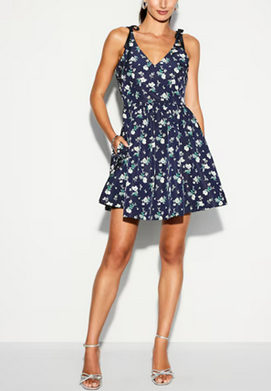
There was this time I was on a shopping spree, and I happened to find myself in Nordstrom. This sparkle catches my eye. It’s a cute black Armani cocktail dress. With sparkles! I can tell a 10 isn’t even close. Lookin’ at the 12, I think, “Looks tight, but that might fit.” In the dressing room, the zipper says “Not!”. So, I grab the 14. I try to zip the thing up. I can hear Giorgio’s pained voice with his thick Italian accent say, “Not today, ragazza!” Reluctantly, I try on the 16. I can zip it up, but breathing? Good luck.
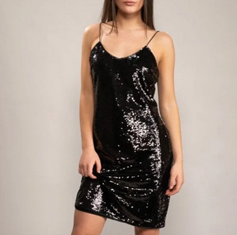
I ain’t going to an 18. Hell, I don’t even know if they make that dress in an 18. Upon my return to my home closet (without the Armani, btw), just to be sure I’m not imagining my size, I check my dress tags: O.N. U.S. 10, Ann Taylor, U.S. 10. Other brands U.S. 12, U.S. 8, U.S. 16. Like, What the Fuck?!
What Size Do I Wear?
We’ve all experienced it: the size that fits at Old Navy feels like a distant dream when trying things on at Zara or Nordstrom. An M at Target is suddenly an L at White House Black Market, or an XL – GASP!
“I normally wear a size 8. How is it that I scarcely fit into a 10 now?” you ask.
It gets worse. I’ve been talking mostly about U.S. number sizes for dresses. For many pieces of clothing, the size is a letter rather than a number. It’s that damn new math. Letter sizes represent a range of number sizes. For example, an “M” may include sizes 8 and 10.
In this article, I mostly discuss U.S. sizes, but other countries have their own sizing. So, if you shop internationally, you will increase the complexity in finding a size that fits you. The U.K, France, Italy, Mexico, and all the Asian countries have different sizing scales from the U.S. and each other (e.g., a U.S. size 10 is a U.K. size 14, approximately a French size 44, etc.)
Back to the U.S., in her “My Green Closet” article, “We Surveyed 1000 Women about Clothing Sizes, This is Why Nothing Fits Right”, which was last updated on 20 February 2024, Verena Erin analyzes survey results. She mentions one result showed that 77% of survey respondents do not fit in a single letter size across their measurements (e.g., M Bust, M Waist, M Hips). That means they wear a different-sized top and bottom. Within the same brand or across brands!

How can I even build a wardrobe for this decade that isn’t just jeans and boyfriend shirts? How did we get into this mess?
This Means War
Well, let’s talk a bit about history. Don’t roll your eyes back. I see that glossy-eyed look you have. Don’t worry, this’ll be interesting. There’s not much to it. Really. There is nothing, because there used to be NO Sizes. Told ya, nothing to this history shit.
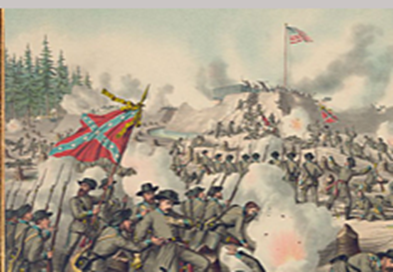
Before the U.S. Civil War began in 1861 (ok, I lied; we have to go over a little bit of history), you’d go to a tailor, and he (they always seemed to be a “he”) would measure you. A few weeks later, you would pick up your new dress, or dungarees, or whatever.
In addition to using a tailor, a vast number of people sewed their family’s clothes at home. Whether by you or by a tailor, all clothing was custom-made.
With the war, the military wanted a bunch of uniforms. Fast! They couldn’t wait for custom-made uniforms for 500,000 men. So, they started categorizing sizes and had garment makers mass-produce the uniforms.
The rest of the industry followed suit (ha!), but after the war, standards from one manufacturer to another, and even within a single manufacturer, were nonexistent.
This remained so until around the 1930’s when the U.S. government began publishing standards for clothing sizes. By the 21st century, those size standards were mostly abandoned. However, Foreign countries have published standards. As does the ISO (International Organization for Standardization) and ASTM International, formerly known as American Society for Testing and Materials. The standards are all voluntary, and no manufacturer strictly adheres to them.


Well, Lauren, what are those standards? Luckily, we have Wikipedia. It has a page on Clothing Sizes that lists an array of U.S. and international clothing size standards. The page also contains sizing grids that show sizes manufacturers dubiously “follow.”
Size Inflation
Annika Lautens, formerly of FashionMagazine.com, posted an article on 21 January 2025 called: “Clothing Sizes Are More Inconsistent Than Ever.” There is a quote in there that states: “A Women’s size 14 in 1937 was equivalent to a size 8 in 1967 which was a size 0 in 2011.”
This “size inflation” has been occurring for decades. Today, some brands are sticking to latter 20th-century sizing; other brands are not making that choice, opting instead to create and use what is commonly referred to as “Vanity Sizing”.
In her Time.com post, “Inside the fight to take back the fitting room” with the slug “how-to-fix-vanity-sizing” Eliana Dockterman explores how vanity sizing made shopping impossible. Her article has wonderful graphics showing how Oprah went from a size 8 in 1995 to a size 6 today, without changing her measurements. And, Joan Collins went from a size 8 in 1983 to a size 2 today.
Eliana also shows the measurement difference between 11 brands, from Ann Taylor to Zara, for a size 8 today. Including the standards for Straight and Curvy body types.
She discusses the diversity of sizes, and offers hope with technology vendors like True Fit and Le Tote, who attempt to track your sizes and shape across clothing brands.
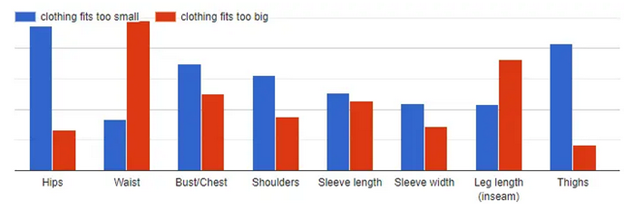
Common wisdom is that as the population’s waistlines grow, sizing is following suit. That may not necessarily be the case. Returning to her survey analysis in her “My Green Closet” article, Verena Erin presents the common fit issues experienced by survey respondents. The number one headache? Waist fit was too big. Hips and thighs being too small were runners-up. Doesn’t seem like the problem is sizing alone. Just saying.
Why Does No One Want to Follow the Standards?
There is a 2011 NPR article about a company called “Alvanon”, the world’s largest maker of mannequin body forms. Tailors and fashion designers worldwide use these mannequin body forms. They are basically big pin cushions shaped kind of like a human torso. This article also discusses the dilemma of sizing women’s clothing.
“From Body Scan To Body Form: Sizing A Clothing Line” by Marisa Peñaloza, explains how the company “Alvanon has built the largest global database of body measurements,…” and from that database of different shapes, Alvanon sells mannequin forms based on unique measurements requested by brands such as Nike, Hugo Boss, Lacoste, J.C. Penney, Levi’s, or one of many other brands. Ed Gribbon, then president of Alvanon, explains: “Every brand looks at their fit as something that’s proprietary, like their ‘secret sauce,’ and none is willing to share that info with anyone else.”
How much difference is there between body shapes?
There is this thing in math called the bell curve.
The Maths, oh fuck! Not the Maths! Lauren! Why are you doing this to us? First history, now the maths? You didn’t say we were going back to school. Ugh!
Ok, bear with me. I’m not asking you to balance your checkbook or anything. Mathematicians use this bell curve to illustrate the distribution of people’s heights and weights. What does a bell curve show about women’s sizes?
From an article on Medium.com entitled: “Using the Bell Curve to Make Accurate Generalizations” by Kris Williams, the largest percentage of women are just under 5’4” tall, with 68% (about 2/3) of women between 5’1” and 5’6”. From the National Institutes of Health (NIH), about two-thirds of women have a BMI between 22 and 33, according to one study.
Professor Lauren, Professor Lauren, but what does all this math mean?
It means that while height varies by nine percent for two-thirds of women, weight varies by 41%! That’s five times as much. It means that women’s shapes are much more diverse than just their height or weight would suggest.
And that’s only two measures: height and weight. Imagine adding in Bust, Waist, Hips, Torso Length, Arm Length, etc. into the mix. Having to come up with standard sizes for the diversity of women’s shapes seems a bit daunting, ya think?.
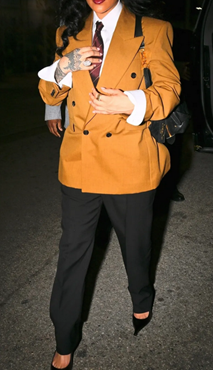
And that is the problem. Each manufacturer targets a certain type of woman’s body, and orders an Alvanon mannequin to fit their target market. The brand then determines what measures affect size. H & M is targeting small flat women and Old Navy is for women with more robust dimensions. Designer patterns for the different aspects of women’s figures are the ‘secret sauce’ for each brand. Again, according to Ed Gribbin, president of Alvanon. “…brands don’t share information on sizing and instead guard their ‘secret sauce’ ferociously. Even if it means their size 4 is really a 6 or a 2 somewhere else.”
Imagine being covered in secret sauce. Ed seems to think we already are. Ha!
The Feedback
Does this make my butt look fat? Well, yes, Susan it does make your butt look junky because that brand uses a hip dimension of 38 inches for your given waist size, rather than the 40 you need for your beautiful curves. No wonder you don’t fit too well in that brand’s pants. You should be shopping Curvy Sizes at Ann Taylor.
I try not to blame my partner for responding honestly to my “how’s this look?” questions. I’d rather know I might be making a fashion faux pas than have my partner try to save my feelings, which then results in everyone behind me snickering.
But What Can I Do, Lauren?
You want items in your wardrobe that not only look good but that you actually wear. If something doesn’t feel comfortable
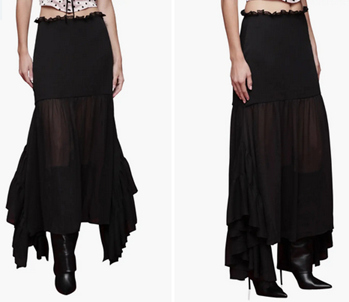
enough, will you really wear it? Raise your hand if you have at least one item in your closet that you never wear because it feels weird. Both of my hands are up. I keep those items front of mind when I am shopping and trying on things. That helps me avoid repeating my old mistakes (though not always successfully).
If I want a new clothing item, I have a couple of go-to brands that I start with. I wear plenty of Old Navy because their stuff tends to fit me well and is comfortable. I also have a heap of Long Tall Sally in my closet. For a tall princess 😉 like me, the name speaks for itself. Their stuff also fits me well and is comfortable. I often wear Long Tall Sally garments, too.
After my go-to brands, I refer to my notes. Well, actually a spreadsheet. I use Microsoft Excel. If I didn’t have access to Excel, I might use Google Sheets. It’s free and easy to use. I need to create a Google account, though, to create a sheet. Another option is just to use a grid I drew in a notebook. Whatever works. Which, for me, at the moment, is Excel.
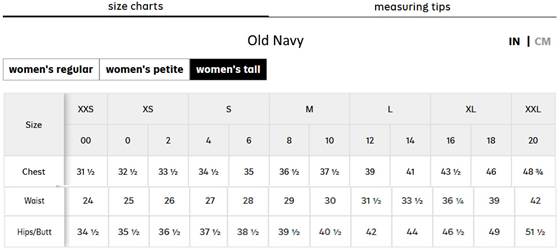
I have a few other brands that I have had some success finding clothing pieces that fit me. I track that info in my spreadsheet. I also have my measurements and the brands’ size charts with notes on how that designer puts them together. The same measurements for two brands’ size 10 do not mean they will both fit me well. The measurements for standard sizes are more of a guideline for some manufacturers; therefore, even when using the exact same measurements, a size 10 from one brand doesn’t fit the same as a size 10 from another. I sometimes have to upsize or downsize to find the size that fits me. Then under my Zara (or Gap, or The Loft, or Express, or another brand’s) section, I might write something like, “Cute pink wool coat. Size L tight across chest.”
I tend to avoid items on sale, at least those from brands I don’t usually buy from. There’s a reason those items are on sale. However, I tend to wait for full-store sales, like Nordstrom’s Annual Anniversary Sale, and buy brands I know work for me.
On the other side of brands that work for me are the ones that don’t. I never buy clothing items from Costco. Not because I have anything against buying clothing in a warehouse. Costco items are usually of high quality and some pieces are actually quite cute. But, it feels like I always have to return whatever pants, tops, dresses, or sweaters that I buy there. The cuts of the items sold at Costco just don’t work on my body.
White House Black Market is another brand I don’t even bother with anymore. No matter how cute those Piper flare pants are, they just don’t fit me well enough for me to wear them. Ditto that One-Button Blazer.
Shopper, know thyself! And, know thy body.
In addition to looking up info in my spreadsheet when shopping at Express, REI, or other physical stores, I also order online. In most cases, I require a tall or long size for an article of clothing to fit, especially pants and maxi dresses. Tall sizes are rarely stocked in-store anymore. I commonly order two different sizes online and return the garments that don’t fit well or just don’t look good. Another reason I like Old Navy is that their shipping is free (a $50 minimum purchase required) and returns are free. Nordstrom and Nordstrom Rack have similar policies. Read the deets on their websites. Most other brands will accept a return in-store at no charge, as well.
Tips for Dealing With Size Differencia
Coupled with my great approaches for addressing the size differences between brands, Verena of My Green Closet also has some ideas:
- Use Brand Sizing Chart and Know Your Measurements: Knowledge is power, baby. I use sizing charts to compare brands’ sizing. It gives me a good starting point to try on items in the store, or when ordering online. But, that means I have to know my measurements. That requires knowing how to measure my body. Here’s a YouTube vid that helps guide women in measuring themselves. A word of caution: just because two size charts have the same measurements for the same size doesn’t mean both will fit the same. Body proportions can affect how a size fits, as well as style, material type, fabric stretchiness, etc.
- Fit Largest Parts First: When looking at size charts, and trying on items, Verena says to “fit your largest parts first!” For example, have that dress fit around your boobs first, and take it in around your midsection. Fitting the dress to your waist and letting out the chest can be problematic.
- Stretchy Clothes: Have you noticed there seems to be more knits out there, and more blends with spandex or elastane? That’s because they str e t c h, and that affects how the garment fits a wider range of people with various measurements, including, potentially, you. Stretchy clothes also tend to be more comfortable.
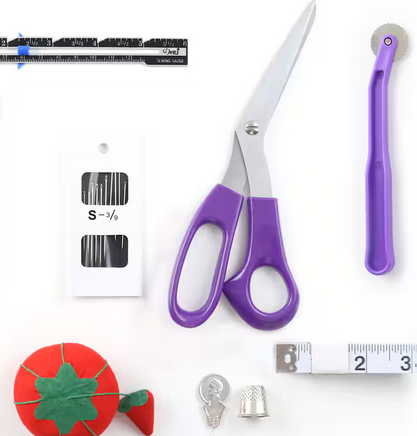
- Alterations: And, lastly, I found a good tailor, and he has saved me a few times with items that didn’t fit just right. I also learned how to do some alterations myself. There is a great sense of satisfaction when I add my own darts to that blouse that was a touch too loose. Alterations can be essential to getting that perfect fit. Heather Handmade has a blog post with a list of “How to’s”
for several common alterations: 36 Sewing and Alterations You Can Do Yourself.
Great ideas, Verena!
How About a Quick Summary?
Most of us have had the experience of a size 10 (or size 2, or size 14) fitting at Old Navy, but the same size not fitting at Zara. What the fuck is up with that?
Well, a little history – there used to be no sizes, but then came the Civil War. The military needed 500,000 uniforms fast and created standard sizing for garment makers to deliver on. However, the U.S. government didn’t establish industry standards until the 1930s. Today no one really adheres to those standards.
The maths – remember the bell curve – shows us that women are very diverse in their shapes. Because of that diversity, each manufacturer focuses on certain body shapes and uses its own measurements for its sizes. They don’t want to share their “secret sauce” of measurements with others in the industry.
It’s still better than before the civil war, when we had to custom-make everything, and most of us had to sew our own garments from scratch at home.
To improve the chances of finding clothes that fit, Lauren and Verena provide a few tips.
- Know thy body measurements! And, know thy brands that fit! Log what does and doesn’t work for you in a spreadsheet or notebook. Follow the “How to Measure Yourself” video to get your measurements.
- Think about clothing items you don’t wear. Why don’t you wear them? In most cases, they don’t get more comfortable later. Buy what fits now and what you’ll wear now.
- Be cautious of items on sale.
- Compare brand sizing charts with your measurements and with each other to have a starting point for sizes to try on in the store or to order online.
- Fit largest parts first. It’s easier to take in the areas that are too loose than to let out the areas that are too tight.
- Order multiple sizes when buying online to find the one that fits. Send the others back.
- Stretchy clothes may be more forgiving and comfortable than items made with other fabrics.
- Alterations. Use a tailor or do them yourself. Read Heather Handmade’s instructions for how to perform the alterations you want.
Once you incorporate these ideas into your clothes shopping routine, you’ll feel more confident and less anxious about finding the size that fits you best.
Last Words
How do you deal with inconsistent sizing when shopping for clothes today? How do you determine whether something is worthy of your closet space and worth wearing? Will our ideas help?
Go ahead and try our ideas and feel free to leave a comment on how it worked out, or didn’t, for you. Oh, to leave a comment, we do need you to create an account on our website. Trying to cut out the bots and trolls, you understand.
Links Used in This Article
https://fashionmagazine.com/style/vanity-sizing
https://time.com/how-to-fix-vanity-sizing
https://www.npr.org/2011/12/11/143004761/from-body-scan-to-body-form-sizing-a-clothing-line
https://kriswilliams.medium.com/using-the-bell-curve-to-make-accurate-generalizations-95960a689e0f
https://mygreencloset.com/clothing-size-fit/
https://www.today.com/style/jeans-don-t-fit-here-s-explanation-inconsistency-women-s-t100419
https://docs.google.com/spreadsheets
https://en.wikipedia.org/wiki/Clothing_sizes
https://www.heatherhandmade.com/sewing-and-alterations
https://www.youtube.com/watch?v=Bri4LC8jldw
Coming Up
In the next post on “Life of Lauren, WTF?!”, we’re talking about groceries that really have Lauren saying, “What the Fuck?!” Things like bell peppers bigger than a baby’s head, one-pound onions, and four pound cabbages the size of bowling balls. These fruits and vegetables aren’t found at some country fair’s 4-H contest. These victuals are at my local grocery store. What the fuck is up with the gigantic produce at Kroger’s Fred Meyer in Seattle?!
Thank you! Send us a note!
Thanks for spending the time to read this post. If you have feedback, article ideas, other suggestions, or just want to send us good karma, go to LifeOfLaurenWTF.com, and after creating your account, you can send Lauren a message. If you are gonna troll, though, just fuck off.
Peace and love everyone, ✌️ ❤️
Lauren
Leave a Reply